IMDRF Coding (AI-Powered Analysis)
The IMDRF Coding module leverages advanced artificial intelligence to automate and streamline the assignment of International Medical Device Regulators Forum (IMDRF) codes for medical device reports. By analyzing complaint descriptions, the system intelligently identifies complex product-specific issues and automatically maps them to the appropriate IMDRF terminologies.
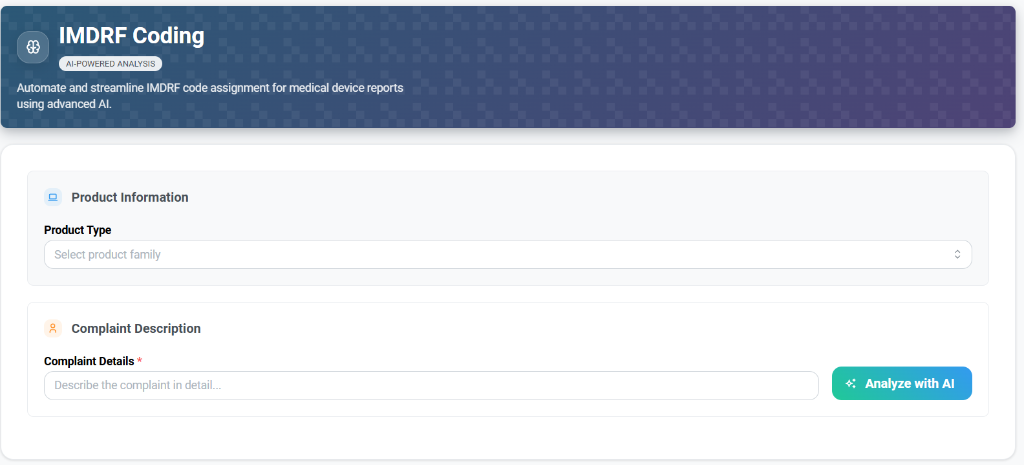
Step 1: Selecting Product Information
The first step in initiating an AI-powered IMDRF analysis is specifying the medical device involved in the complaint.
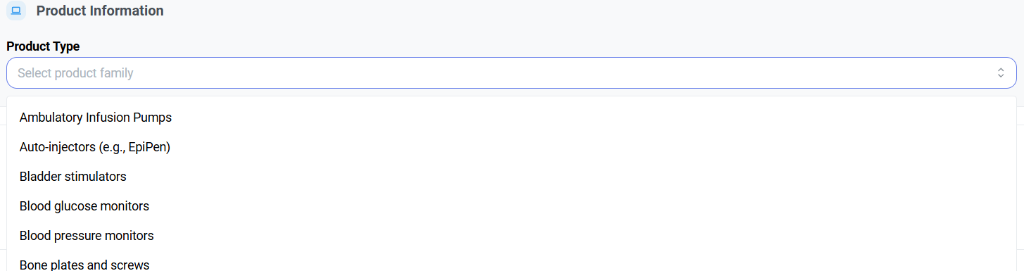
- Navigate to the Product Information section.
- Click the Product Type dropdown menu.
- Select the appropriate product family from the extensive list (e.g., Ambulatory Infusion Pumps, Blood glucose monitors, Bone plates and screws). Note: Accurate product categorization ensures the AI context window is specifically tailored to the mechanical and clinical nuances of that device family.
Step 2: Inputting Complaint Details
Once the product is defined, provide the clinical narrative or patient feedback.

- Go to the Complaint Description section.
- In the Complaint Details text box, enter a concise but comprehensive narrative (e.g., "low glucose level").
- Click the Analyze with AI button to trigger the natural language processing (NLP) engine. The system will parse the text and cross-reference it against official IMDRF Annexures.
Step 3: Reviewing AI-Generated Analysis (Codes, Modes, and Harms)
The AI rapidly processes the input and generates a multi-faceted analysis grouped by official terminologies.
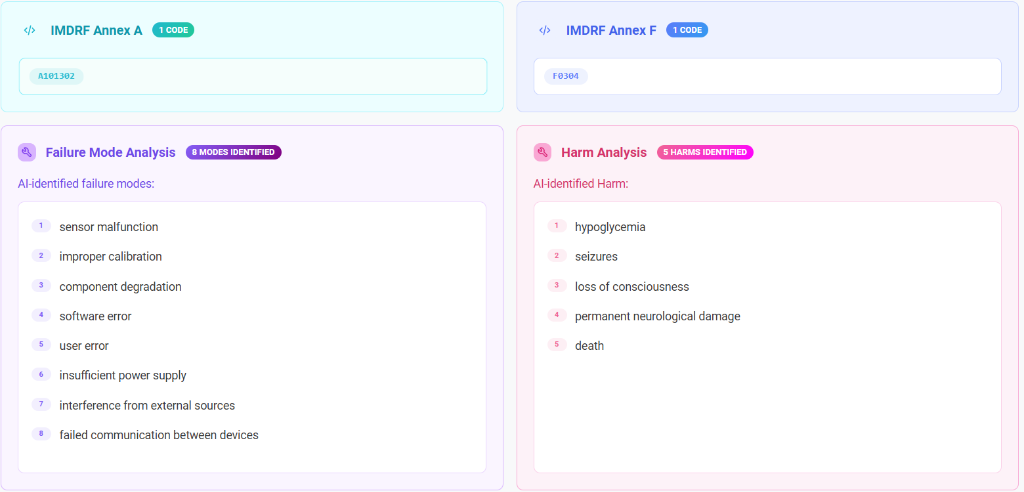
IMDRF Annex Codes
The system isolates the exact regulatory codes necessary for compliance reporting.
- IMDRF Annex A (Medical Device Problem Codes): Identifies the specific device malfunction (e.g.,
A101302). - IMDRF Annex F (Health Impact Codes): Identifies the clinical consequence to the patient (e.g.,
F0304).
Failure Mode & Harm Analysis
Beyond simple coding, the platform provides predictive situational analysis based on the complaint text and device type.
- Failure Mode Analysis: The AI anticipates potential technical root causes (e.g., sensor malfunction, improper calibration, software error).
- Harm Analysis: The system predicts parallel clinical consequences (e.g., hypoglycemia, loss of consciousness, seizures).
Step 4: Reviewing Hazard and Hazard Situation Analysis
Finally, the system outputs a comprehensive risk summary to assist in post-market surveillance (PMS) and severity profiling.
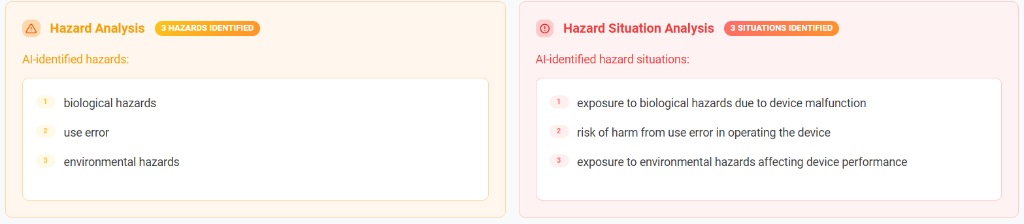
- Hazard Analysis: Categorizes the fundamental nature of the risk (e.g., biological hazards, use error, environmental hazards).
- Hazard Situation Analysis: Contextualizes the hazard within a real-world scenario (e.g., exposure to biological hazards due to device malfunction, risk of harm from use error in operating the device).
By adopting this AI-driven approach, organizations significantly reduce manual coding errors, accelerate complaint closure rates, and maintain a highly consistent standard for regulatory reporting submissions.